AI agents are moving marketing from automation to autonomy. Instead of simply executing pre-set rules, these systems analyse data, make decisions, and take action with minimal human input. For marketers managing paid campaigns, content pipelines, and customer interactions across multiple channels, that shift changes how work actually gets done. This guide explains what AI agents are, how they operate inside a marketing stack, where they deliver real value, and where their limitations still require human oversight.
Key Takeaways
- AI agents differ from chatbots and automation tools because they can reason, plan, and act independently across multi-step tasks.
- Common use cases include campaign bidding, audience targeting, content generation, customer service, and performance reporting.
- Benefits include faster optimisation cycles, reduced manual workload, and more consistent execution at scale.
- Limitations include data quality dependency, limited strategic judgement, and the need for human review on brand-sensitive decisions.
- Successful adoption depends on clear goals, clean data, and defined boundaries for what the agent can act on without approval.
What Are AI Agents in Digital Marketing?
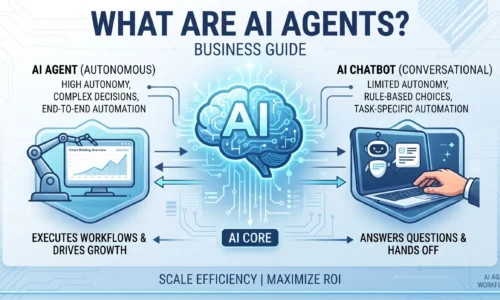
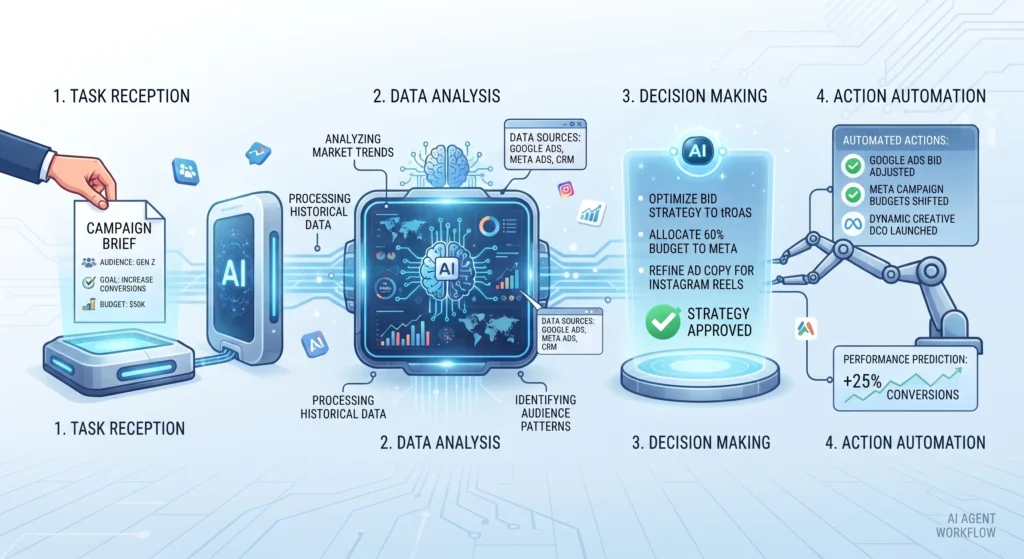
An AI agent is a software system that perceives data, makes decisions, and performs actions toward a defined goal with limited human intervention. In digital marketing, this means an agent can monitor campaign performance, identify an underperforming ad set, adjust the bid or budget, and report the outcome — without a marketer manually reviewing every data point first.
This differs from traditional marketing automation, which follows fixed if-this-then-that rules. A standard automation tool might pause an ad if cost-per-click exceeds a set threshold. An AI agent, by contrast, can evaluate multiple signals — conversion rate, audience saturation, competing campaigns, time of day — and decide on a response that wasn’t explicitly programmed in advance.
How Does an AI Marketing Agent Work?
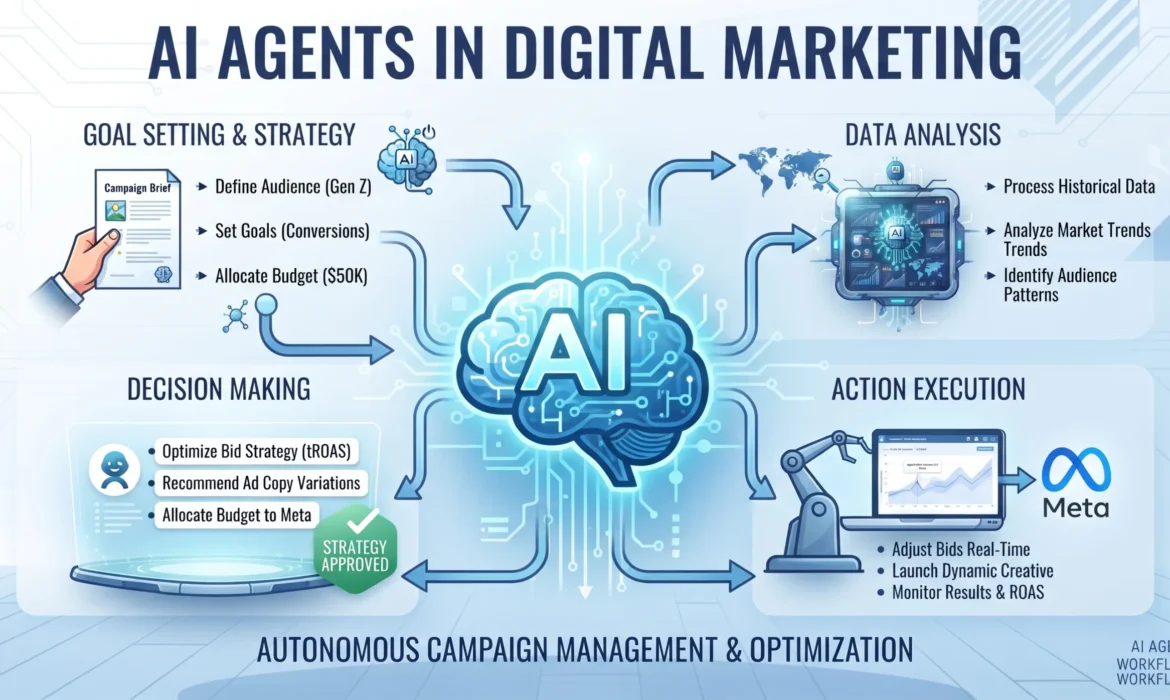
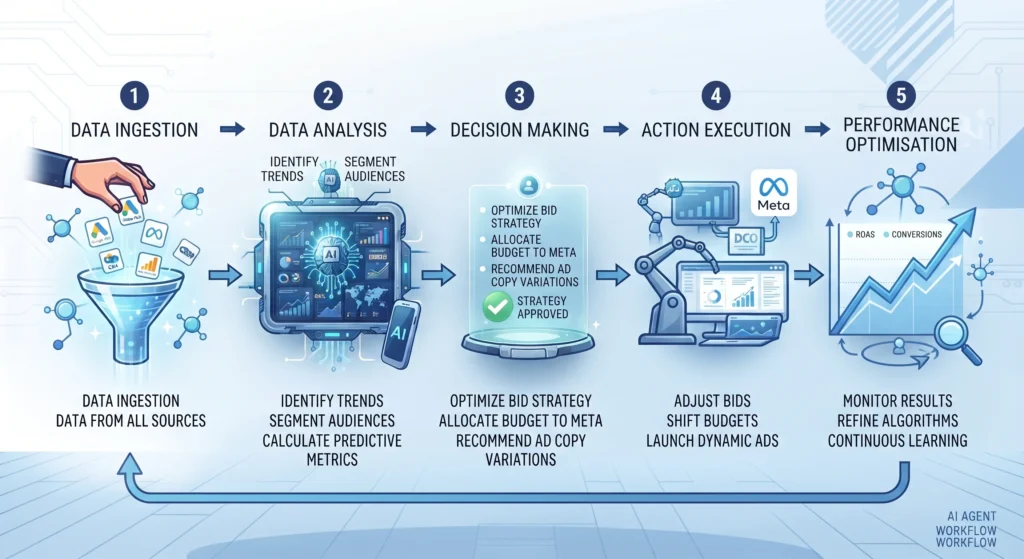
AI marketing agents generally operate through a continuous loop: data collection, analysis, decision-making, action, and optimisation. Understanding this loop clarifies what the agent can reasonably be trusted to handle, and what still needs a human in the process.
- Data collection — The agent pulls data from connected sources, such as Google Ads, Meta Ads, GA4, or a CRM.
- Analysis — It evaluates this data against defined goals, like cost-per-acquisition targets or engagement benchmarks.
- Decision-making — Using machine learning models or rule-based logic (often both), it determines the next best action.
- Action — The agent executes the action directly — adjusting a bid, pausing an ad, sending a follow-up message, or generating a report.
- Optimisation — It monitors the outcome of its own action and feeds that result back into future decisions.
This loop runs continuously, which is what separates an agent from a one-off automation script. The agent keeps learning from each cycle rather than executing the same static rule indefinitely.
Core Use Cases of AI Agents in Digital Marketing
AI agents are not a single tool — they’re applied differently depending on the marketing function. Below are the areas where adoption is most mature.
Paid Advertising Management
AI agents can monitor Google Ads, Meta Ads, and Microsoft Ads accounts in real time, adjusting bids and budgets based on performance signals. Instead of a marketer manually checking dashboards each morning, the agent flags underperforming ad sets and reallocates spend toward higher-converting campaigns. This is particularly useful for accounts running dozens of ad groups where manual monitoring isn’t practical.
Content Generation and Optimisation
Agents assist with drafting ad copy variations, email subject lines, and product descriptions, then test these variations against performance data to identify what resonates. Some tools go further, adjusting content tone or structure based on which version drives the strongest click-through or conversion rate.
Customer Service and Lead Qualification
Conversational AI agents handle initial customer enquiries, qualify leads based on predefined criteria, and route high-value prospects to a sales team. Unlike a basic chatbot script, an agent can hold context across a multi-turn conversation and adapt its responses based on what the customer has already said.
SEO and Content Strategy Support
AI agents can analyse search intent, identify content gaps against competitor pages, and suggest topic clusters based on keyword relationships. This supports — but doesn’t replace — the editorial judgement needed to build genuine topical authority.
Reporting and Performance Analysis
Agents compile cross-channel performance data into summarised reports, flagging anomalies such as a sudden spend spike or conversion drop. This reduces the manual reporting burden and surfaces issues faster than a weekly review cycle would.
AI Agents vs AI Chatbots: What’s the Difference?
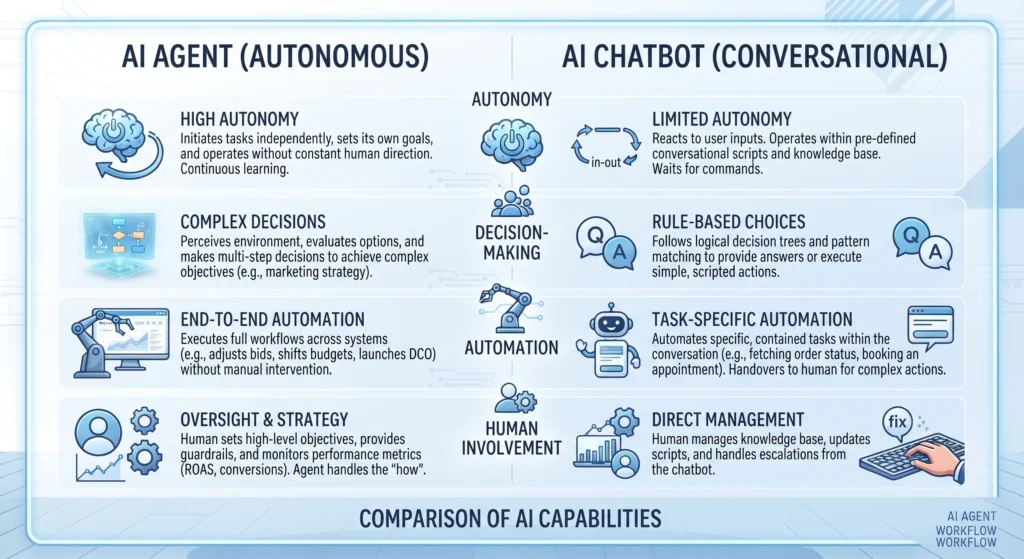
Marketers frequently use these terms interchangeably, but they describe different levels of capability. A chatbot follows scripted or semi-scripted conversation flows. An AI agent reasons through multi-step tasks and takes autonomous action.
| Factor | AI Agent | AI Chatbot |
|---|---|---|
| Autonomy | Acts independently across multiple steps | Responds within a defined conversation script |
| Decision-making | Evaluates multiple data signals before acting | Follows pre-set rules or decision trees |
| Task scope | Can execute actions (adjust bids, send emails, update records) | Primarily limited to answering queries |
| Human involvement | Requires oversight on strategic or sensitive decisions | Requires human handoff for complex queries |
| Learning | Improves through feedback loops over time | Rarely adapts beyond its programmed scripts |
Choose an AI agent when the task requires ongoing decision-making across changing data — bid management, lead scoring, campaign optimisation. Choose a chatbot when the task is primarily conversational and the responses can be reasonably scripted — FAQs, order status, basic support.
How to Implement an AI Agent in Your Marketing Stack
Rolling out an AI agent works best as a staged process rather than a full handover of control.
- Define a specific goal. Don’t deploy an agent to “improve marketing.” Define a narrow objective, such as reducing cost-per-lead on a specific campaign.
- Audit your data quality. An agent’s decisions are only as reliable as the data feeding it. Clean up tracking gaps and duplicate records before connecting an agent to live campaigns.
- Set clear boundaries. Decide what the agent can act on autonomously (minor bid adjustments) versus what requires approval (budget increases above a set threshold).
- Run a pilot on a limited budget. Test the agent on a smaller campaign before extending it across the full account.
- Review outputs regularly. Even after deployment, schedule periodic reviews of the agent’s decisions to catch drift or unexpected behaviour.
- Scale gradually. Expand the agent’s scope only after it has demonstrated consistent, measurable results.
Benefits of AI Agents in Digital Marketing
- Faster optimisation cycles. Agents can react to performance data within minutes rather than waiting for a scheduled manual review.
- Reduced manual workload. Repetitive tasks like bid adjustments and basic reporting shift away from marketers, freeing time for strategy.
- Consistency at scale. An agent applies the same decision logic across hundreds of campaigns without fatigue or inconsistency.
- Better use of real-time data. Agents can respond to signals — a traffic spike, a sudden drop in conversions — far faster than a human monitoring a dashboard.
Challenges and Limitations of AI Agents
AI agents are useful, not infallible. Several limitations matter when deciding how much control to hand over.
- Data dependency. An agent making decisions on incomplete or poorly tagged data will make poor decisions, just faster.
- Limited strategic judgement. Agents optimise toward defined metrics. They don’t understand brand positioning, seasonal context, or long-term strategy the way a marketer does.
- Risk of over-automation. Giving an agent too much unchecked control can lead to budget mismanagement or brand-inconsistent messaging if boundaries aren’t set correctly.
- Transparency gaps. Some agents operate as a “black box,” making it hard to understand exactly why a specific decision was made.
- Integration complexity. Connecting an agent across multiple platforms (ad accounts, CRM, analytics) requires clean API access and ongoing maintenance.
Common Mistakes When Adopting AI Agents
- Deploying an agent without a clear goal. Vague objectives lead to vague — or counterproductive — actions.
- Skipping the data audit. Poor tracking setups undermine even the most sophisticated agent.
- Removing human oversight too early. Full autonomy before the agent has proven reliable increases risk unnecessarily.
- Treating every tool labelled “AI agent” the same way. Capabilities vary significantly between platforms — verify what a tool actually automates before relying on it.
- Ignoring the review cycle. Agents can drift from their original objective over time without regular checks.
Best Practices for Using AI Agents in Marketing
- Start with one well-defined use case rather than a full-stack rollout.
- Keep a human in the loop for budget-sensitive or brand-sensitive decisions.
- Review agent-driven decisions weekly during the first few months of deployment.
- Pair agents with strong conversion tracking so the data they act on reflects reality.
- Document the boundaries given to each agent so the team understands what it can and can’t do independently.
Frequently Asked Questions
What’s the difference between AI agents and marketing automation tools?
Marketing automation tools follow fixed, pre-set rules. AI agents evaluate multiple data signals and make independent decisions, adapting their actions based on outcomes rather than following a single static rule.
Can AI agents fully replace a digital marketing team?
No. AI agents handle repetitive, data-driven tasks efficiently, but strategic decisions, brand judgement, and creative direction still require human input.
Are AI agents expensive to implement?
Costs vary by platform and scope. Many advertising platforms now include agent-style automation within existing tools, while standalone AI agent platforms typically involve a separate subscription cost.
What risks come with giving an AI agent too much control?
Unchecked autonomy can lead to budget overspend, inconsistent messaging, or decisions based on flawed data. Setting clear action boundaries reduces this risk.
Which marketing tasks are best suited to AI agents right now?
Bid management, lead qualification, reporting, and basic content variation testing are currently the most mature use cases, given how data-driven these tasks are.
Final Takeaway
AI agents give marketers a way to handle repetitive, data-heavy tasks faster and more consistently than manual processes allow. The technology works best as a layer of support for a defined, narrow objective — not a wholesale replacement for marketing strategy or judgement. Start small, maintain clear boundaries, and review outputs regularly before expanding an agent’s scope across your campaigns.