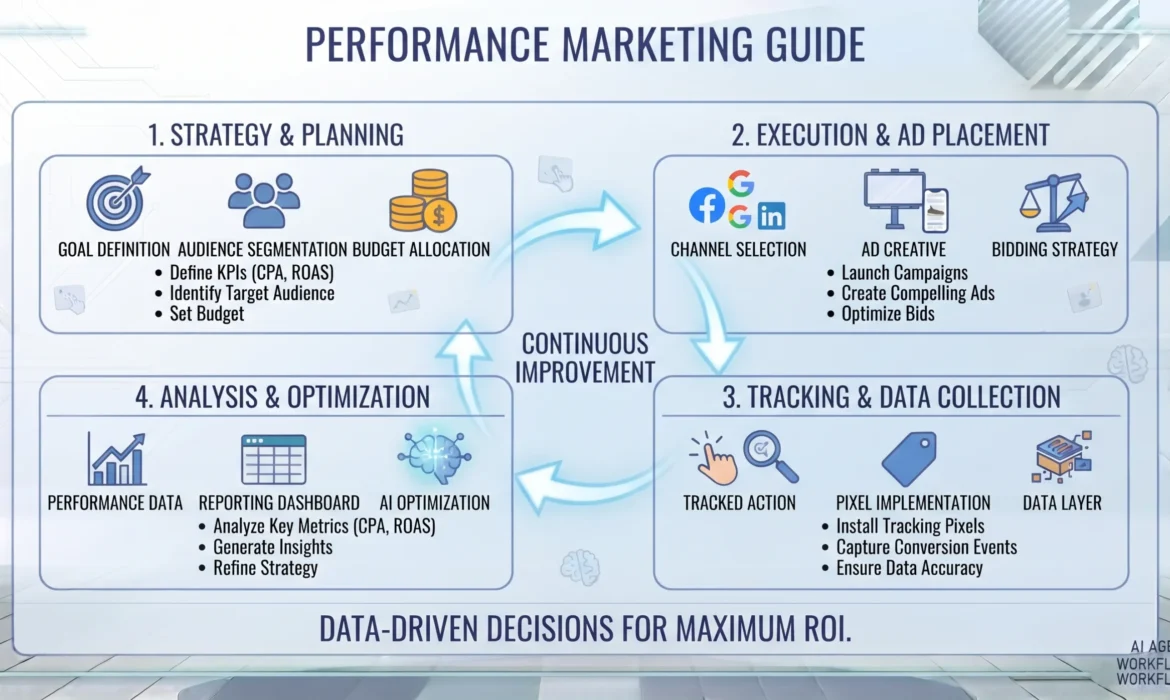
Most advertising used to be a leap of faith. You’d put a message in front of an audience, cross your fingers, and wait to see if sales moved. Performance marketing exists because that approach doesn’t scale — businesses need to know exactly what their advertising spend is producing, down to the pound. This guide explains what performance marketing actually means, how it works across channels like Google, Meta, and affiliate networks, and how to build a programme that ties every pound spent to a measurable result.
What Is Performance Marketing?
Performance marketing is a form of digital advertising where businesses pay only when a specific, measurable action occurs — a click, a lead, a sale, or an app install — rather than paying upfront for exposure. It covers channels such as paid search, paid social, affiliate marketing, and programmatic display, all unified by one principle: spend is tied directly to results. Platforms like Google Ads and Meta Ads use conversion data to optimise campaigns automatically, which means accurate tracking isn’t optional — it’s the foundation the entire model depends on.
Key Takeaways
- Performance marketing ties ad spend directly to measurable outcomes — leads, sales, installs — rather than impressions or reach alone.
- It spans several channels, including paid search, paid social, affiliate marketing, and programmatic display, each with different payment models.
- Accurate conversion tracking is the backbone of performance marketing; without it, automated bidding systems optimise toward the wrong signals.
- Common pricing models include CPC (cost per click), CPA (cost per acquisition), CPL (cost per lead), and CPI (cost per install).
- The biggest performance marketing failures usually come from weak tracking, vanity-metric reporting, and testing too many variables at once.
What Is Performance Marketing and Why Does It Matter?
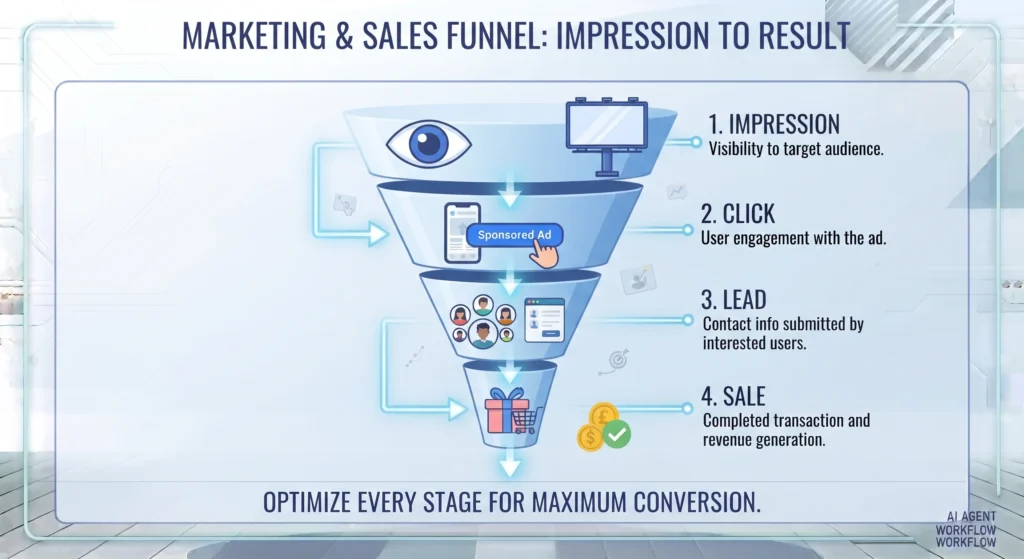
Performance marketing is a results-driven approach to advertising where success is measured by concrete business outcomes rather than exposure metrics like impressions or reach. Instead of paying a fixed fee to display an ad, advertisers typically pay when a user takes a defined action — clicking through, submitting a form, completing a purchase, or installing an app.
This matters because it shifts risk away from the advertiser. A billboard charges the same whether ten people or ten thousand people glance at it. A performance marketing campaign, by contrast, only costs money when something measurable happens. That accountability is why performance marketing has become the dominant model across Google Ads, Meta Ads, TikTok Ads, and affiliate networks.
It also matters because of what it enables technically. Automated bidding systems — Google’s Target CPA, Meta’s Lowest Cost bidding, and similar tools on other platforms — rely entirely on conversion data to decide who to show ads to and how much to bid. A performance marketing strategy without reliable tracking isn’t really performance marketing at all; it’s guesswork with better dashboards.
How Does Performance Marketing Actually Work?
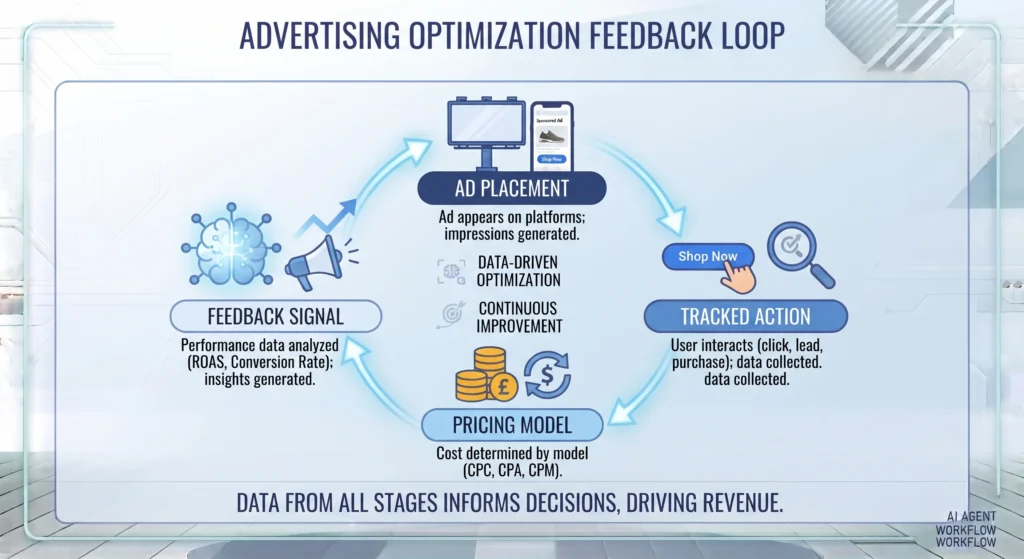
Performance marketing runs on a feedback loop between four connected elements:
- An ad placement — the search ad, social post, banner, or affiliate link the user interacts with.
- A tracked action — the click, lead, or sale that counts as a “conversion” for that campaign.
- A pricing model — the basis on which the advertiser pays (per click, per acquisition, per lead, and so on).
- A feedback signal — conversion data sent back to the platform, which informs bidding, targeting, and budget allocation.
When a user clicks a Google Ads search result and later submits a contact form, that conversion is recorded and attributed back to the keyword, ad, and campaign that drove it. Google Ads then uses that signal to refine who else it shows the ad to. The same loop runs on Meta Ads through the Meta Pixel and Conversions API, and on affiliate networks through tracking links and postback URLs. For the technical detail on how that tracking layer is built, see our guide to conversion tracking.
Important Subtopics in Performance Marketing
Paid Search Performance Marketing
Paid search, primarily through Google Ads and Microsoft Ads, targets users actively searching for a product or service. Because intent is high, paid search often produces strong conversion rates, and pricing is typically based on cost per click (CPC) combined with Smart Bidding strategies like Target CPA or Maximise Conversions.
Paid Social Performance Marketing
Paid social campaigns on Meta Ads, TikTok Ads, and similar platforms target users based on behaviour, interests, and demographics rather than active search intent. These campaigns often use a mix of awareness and conversion-optimised bidding, and they depend heavily on creative testing since users aren’t actively searching for a solution when they see the ad.
Affiliate Marketing
Affiliate marketing pays publishers or partners a commission when their referral leads to a sale or lead, usually tracked through unique affiliate links or codes. It’s a pure performance model in its original form — no sale, no payment — which makes tracking accuracy especially critical.
Programmatic Advertising
Programmatic advertising automates the buying of display, video, and native ad inventory through real-time bidding exchanges. It can operate on a performance basis (CPA, CPL) or an exposure basis (CPM), and it’s often used to extend reach once core search and social channels have been optimised.
Email and Affiliate Hybrid Models
Some performance marketing programmes blend email marketing with affiliate-style tracking, paying partners based on the sales or leads generated from their email list rather than a flat sponsorship fee.
How to Build a Performance Marketing Programme: Step-by-Step
- Define the conversion that matters. Decide whether success means a sale, a lead, a sign-up, or an app install before spending a single pound on ads.
- Set up accurate tracking first. Implement conversion tracking across every platform you plan to use — Google Ads, GA4, Meta Pixel, or affiliate tracking links — before launching campaigns.
- Choose the right pricing model. Match the payment structure (CPC, CPA, CPL, CPI) to the channel and the stage of the funnel you’re targeting.
- Select channels based on intent. Use paid search for high-intent audiences, paid social for discovery and retargeting, and affiliate or programmatic for extended reach.
- Launch with a test budget. Run a controlled test phase to establish baseline cost-per-conversion figures before scaling spend.
- Let automated bidding learn. Give platforms like Google Ads and Meta Ads enough conversion volume and time (typically one to two weeks) to optimise before judging performance.
- Scale what works, cut what doesn’t. Reallocate budget toward the campaigns, audiences, and creatives producing the lowest cost per acquisition.
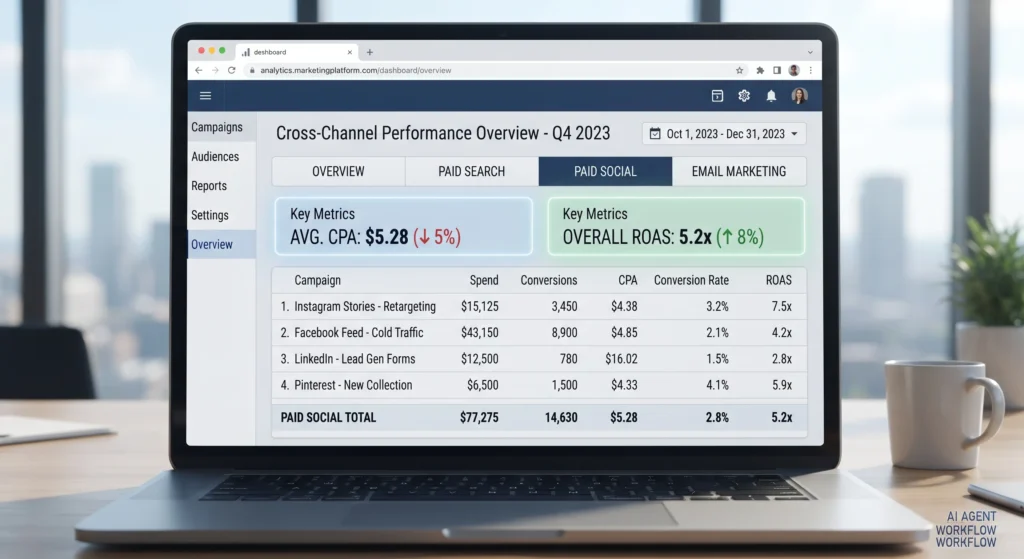
A Practical Example of Performance Marketing in Action
Consider a mid-sized e-commerce brand running both Google Ads and Meta Ads. The brand sets a target cost per acquisition (CPA) of £25 for Google Ads Smart Bidding and a parallel Meta Ads campaign using Lowest Cost bidding optimised for purchases. Both campaigns share the same GA4 purchase event as their source of truth for conversion value, so performance can be compared on equal terms rather than relying on each platform’s self-reported numbers. After two weeks of data collection, the brand finds that Google Ads delivers a lower CPA for branded search terms, while Meta Ads performs better for prospecting new customers through lookalike audiences. Budget is then reallocated accordingly — more spend toward Meta for top-of-funnel growth, more toward Google Ads for capturing existing demand.
Benefits of a Strong Performance Marketing Strategy
- Measurable return on investment — every pound of spend can be tied back to a specific outcome.
- Efficient budget allocation — underperforming campaigns can be identified and paused quickly rather than running on assumption.
- Scalable growth — once a channel proves a reliable cost per acquisition, budget can be increased with reasonable confidence in the outcome.
- Continuous optimisation — automated bidding systems improve targeting over time as more conversion data accumulates.
- Cross-channel comparison — a shared measurement framework, such as GA4, allows fair comparison between paid search, paid social, and affiliate performance.
Challenges and Limitations of Performance Marketing
- Dependence on accurate tracking — performance marketing is only as reliable as the conversion data feeding it; broken tracking produces misleading results.
- Attribution inconsistencies — Google Ads, Meta Ads, and GA4 often report different conversion numbers for the same period due to differing attribution models.
- Rising privacy restrictions — cookie limitations and platform privacy changes have reduced the accuracy of browser-based tracking, pushing more advertisers toward server-side solutions.
- Short-term bias — an overemphasis on last-click conversions can undervalue upper-funnel activity, like paid social or display, that contributes to a sale without being the final touchpoint.
- Diminishing returns at scale — cost per acquisition often rises as campaigns scale into less qualified audiences, requiring ongoing creative and targeting refinement.
Common Performance Marketing Mistakes
- Optimising for the wrong metric, such as click-through rate, instead of the actual business outcome like revenue or qualified leads.
- Launching without a tracking audit, resulting in weeks of wasted spend before a broken conversion tag is noticed.
- Testing too many variables simultaneously, making it impossible to identify which change actually improved performance.
- Judging performance too early, before automated bidding systems have had enough conversion volume to leave the learning phase.
- Ignoring assisted conversions, which undervalues channels that support a sale without being the last click before it.
Best Practices for Running Performance Marketing Campaigns
- Get tracking right before scaling spend. Verify every conversion tag fires correctly and only once per action.
- Use a shared source of truth, such as GA4, to compare performance fairly across different ad platforms.
- Give automated bidding time to learn, generally one to two weeks, before making major budget changes.
- Test one variable at a time, whether it’s creative, audience, or bidding strategy, to isolate what’s actually driving improvement.
- Review attribution models regularly, since over-reliance on last-click data can misrepresent which channels actually contribute to conversions.
Frequently Asked Questions
What is the difference between performance marketing and brand marketing?
Performance marketing measures success through specific, trackable actions like sales or leads, with spend directly tied to results. Brand marketing focuses on long-term awareness and perception, and its impact is harder to measure in the short term. Most mature advertising strategies use both, with performance marketing driving near-term revenue and brand marketing building the audience performance campaigns later convert.
Which channels count as performance marketing?
Paid search (Google Ads, Microsoft Ads), paid social (Meta Ads, TikTok Ads), affiliate marketing, and programmatic display all fall under performance marketing when spend is tied to a measurable action rather than pure exposure. The specific pricing model — CPC, CPA, CPL, or CPI — varies by channel and campaign objective.
How much should I spend on performance marketing?
There’s no universal figure, since budget depends on the business’s target cost per acquisition, profit margins, and growth goals. A common approach is to start with a test budget sufficient to generate enough conversions for the chosen platform’s bidding algorithm to optimise effectively, then scale based on the resulting cost-per-acquisition data.
Why do my conversion numbers differ across platforms?
Google Ads, Meta Ads, and GA4 each use their own attribution model and tracking window, so some variation in reported conversions is normal. Large or growing discrepancies, however, usually indicate a tracking configuration issue that’s worth investigating, as outlined in our conversion tracking guide.
Do I need a large budget to run performance marketing campaigns?
No. Performance marketing can work at a range of budget levels, since the pricing model means spend is tied to actual results rather than a fixed media buy. That said, very small budgets can struggle to generate enough conversion volume for automated bidding systems to optimise effectively, which is why a short test phase is recommended before judging a campaign’s potential.
Final Takeaway
Performance marketing turns advertising from a cost centre into a measurable growth engine, but only when the measurement itself is solid. Choosing the right channels and pricing models matters, yet none of it works without accurate tracking feeding the system good data. Start by defining the conversion that actually matters to the business, build the tracking foundation first, and give automated bidding systems the time and data they need to do their job. Get that discipline right, and performance marketing becomes one of the most accountable forms of growth available to any business.
For the tracking foundation this entire model depends on, see our guide to conversion tracking, and for channel-specific detail, explore our guides on Google Ads campaign optimisation and Meta Ads: The Complete Facebook & Instagram Advertising Guide.


