Most business owners have heard the term “AI agent” thrown around in the same breath as chatbots, automation tools, and generative AI. But an AI agent is a distinct piece of technology — one capable of making decisions and taking action on its own, rather than simply responding to a prompt. Understanding that distinction matters, because it changes how you should plan, budget, and implement AI inside your business. This guide explains what AI agents actually are, how they differ from traditional automation and chatbots, and how marketing, sales, and operations teams are putting them to work in 2025 and beyond.
Key Takeaways
- An AI agent is software that can plan, decide, and act independently to complete a goal, rather than just generate a response to a single prompt.
- AI agents differ from chatbots because they can use tools, make multi-step decisions, and complete tasks without constant human input.
- Businesses are already using AI agents for customer service, ad campaign management, data analysis, lead qualification, and reporting.
- The biggest risks come from poor oversight, unclear goals, and handing agents too much autonomy too soon.
- Starting with a narrow, well-defined use case is the safest way to introduce AI agents into a business workflow.
What Is an AI Agent?
An AI agent is a system built on artificial intelligence that can perceive information, make a decision, and carry out an action to reach a specific goal — largely without step-by-step human instruction.
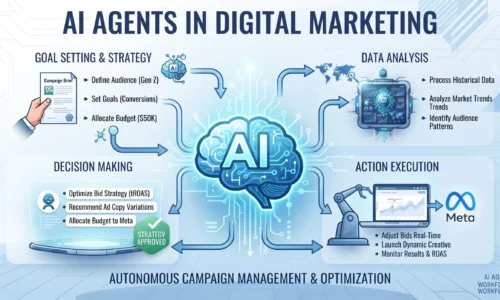
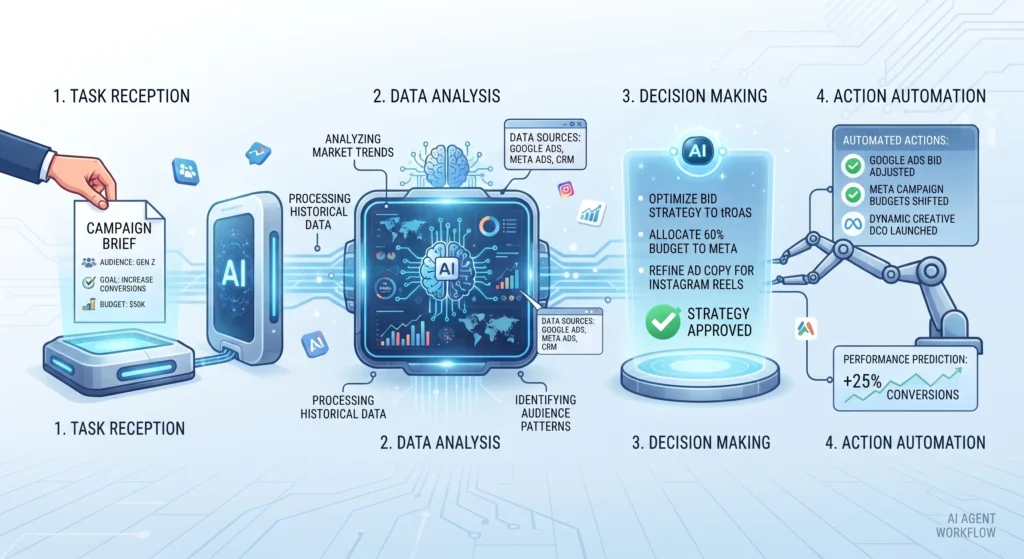
Unlike a standard AI chatbot, which waits for a prompt and returns a single response, an AI agent can break a goal down into smaller tasks, use external tools (such as a CRM, an ad platform, or a spreadsheet), check its own results, and adjust its next move based on what it finds. In practice, this might mean an agent that monitors a Google Ads account, identifies underperforming keywords, pauses them, and reallocates budget — all without a marketer manually reviewing each step.
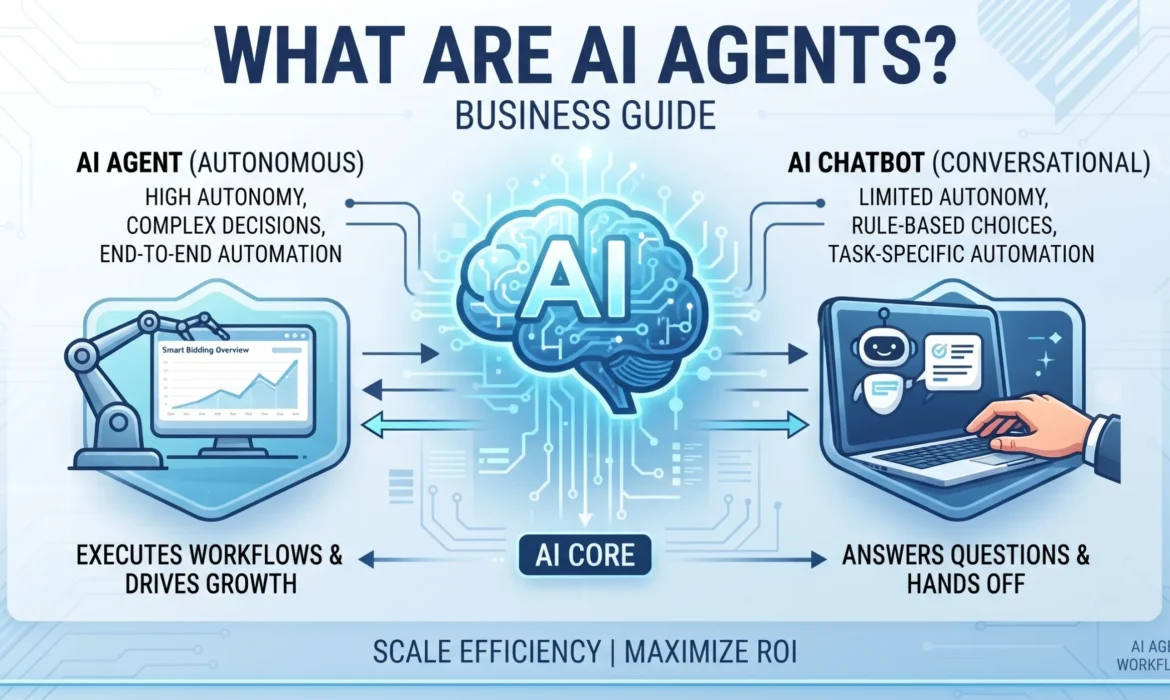
The core difference comes down to autonomy. A chatbot talks. An agent acts.
Why Do AI Agents Matter for Businesses?
AI agents matter because they shift AI from being a tool you operate to a system that operates on your behalf. For businesses with limited marketing or operations headcount, that shift can be significant.
A small team running paid advertising, for example, typically spends hours each week pulling reports, checking performance, and adjusting bids or budgets manually. An AI agent can handle much of that monitoring continuously, flagging only the decisions that genuinely need a human judgement call. This doesn’t remove the need for strategy or oversight — it changes where human attention is spent, moving it away from repetitive monitoring and toward higher-value decisions.
How Do AI Agents Work?
AI agents generally follow a repeating cycle: gather information, reason about it, decide on an action, execute that action, and then evaluate the outcome before starting the cycle again.
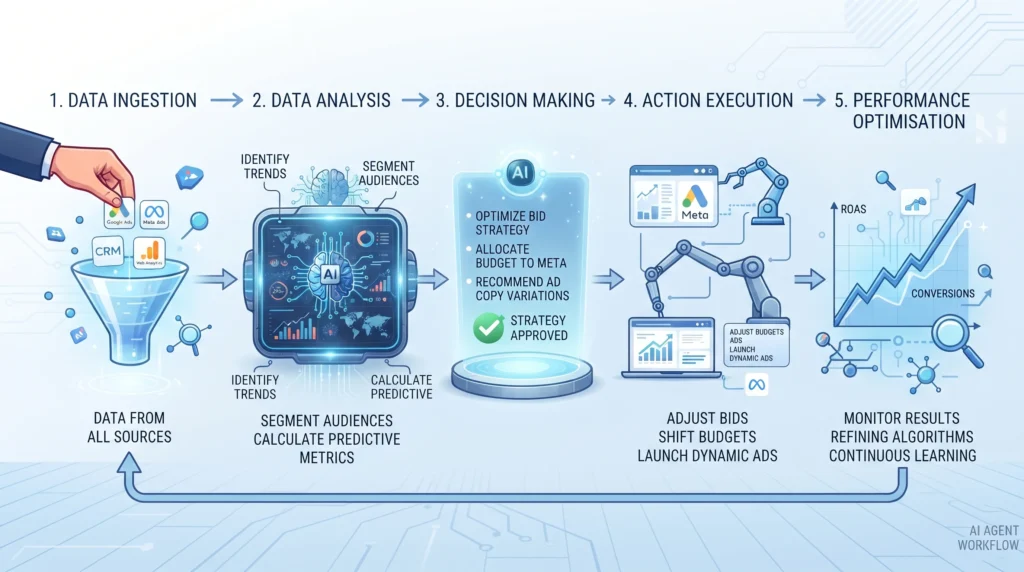
Most AI agents used in business settings are built on a few core components:
- A language or reasoning model – typically a large language model (LLM) that interprets instructions and context.
- Memory – the ability to retain information from earlier steps or previous sessions, so the agent doesn’t start from zero each time.
- Tools or integrations – connections to external systems such as a CRM, ad platform, email tool, or database, which the agent can actually use to take action.
- A planning or decision layer – logic that determines what to do next based on the goal and the current situation.
- Feedback loops – a way for the agent to check whether its action worked and adjust accordingly.
This is what separates an agent from a simple automation rule. A basic automation says “if X happens, do Y.” An AI agent is capable of reasoning through situations that weren’t explicitly programmed in advance.
Types of AI Agents Businesses Commonly Use
Not all AI agents are built the same way or serve the same purpose. Broadly, businesses tend to deploy four categories:
- Task-specific agents – built to handle one narrow job well, such as summarising customer tickets or drafting ad copy variations.
- Workflow agents – coordinate multiple steps across a process, such as qualifying a lead, updating the CRM, and scheduling a follow-up email.
- Multi-agent systems – several agents working together, each handling a different part of a larger task (for example, one agent researching keywords while another writes ad copy and a third monitors budget pacing).
- Autonomous research or analysis agents – designed to pull data from multiple sources, synthesise it, and produce insights or recommendations with minimal human input.
AI Agents vs AI Chatbots: What’s the Difference?
AI agents and AI chatbots are often confused because both rely on similar underlying language models. The difference lies in autonomy, decision-making, and the ability to act.
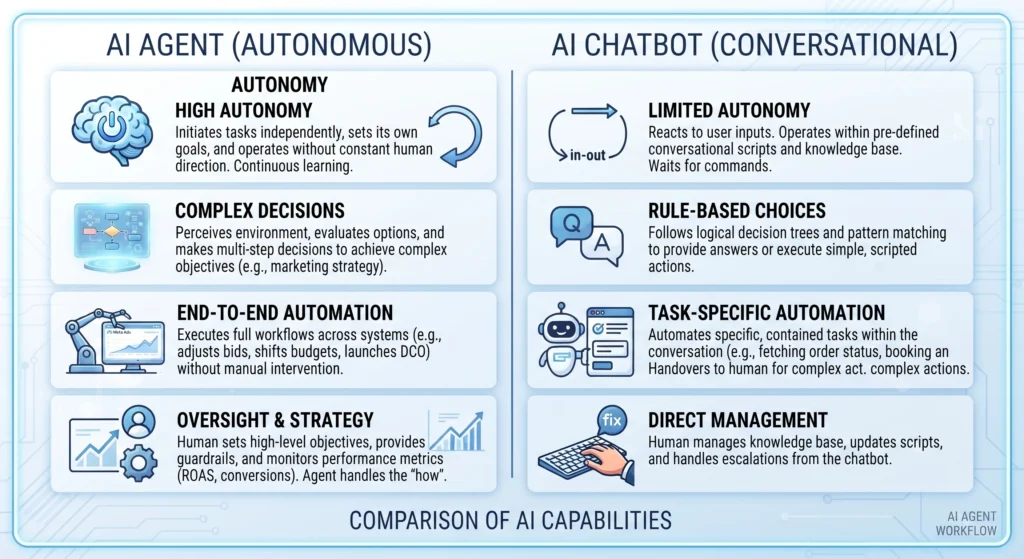
| Feature | AI Chatbot | AI Agent |
|---|---|---|
| Primary function | Responds to user messages | Completes multi-step goals |
| Decision-making | Minimal — follows a script or single prompt | Can plan and adjust its own next steps |
| Tool use | Usually limited or none | Can use external tools and systems |
| Human input needed | Required for each new request | Needed mainly for setup, goals, and oversight |
| Typical use case | Answering FAQs, basic support | Campaign optimisation, reporting, lead workflows |
If you need something to answer customer questions instantly, a chatbot is often sufficient. If you need something to monitor, decide, and act across an ongoing process, an AI agent is the better fit.
Practical Examples of AI Agents in Business
AI agents are already active across several business functions:
- Paid advertising management – agents that monitor Google Ads or Meta Ads performance, adjust bids, pause underperforming ads, and reallocate budget toward better-performing campaigns.
- Customer service – agents that handle multi-step support requests, such as processing a refund by checking order status, verifying eligibility, and issuing the refund without human escalation.
- Sales and lead qualification – agents that review inbound leads, score them based on defined criteria, update the CRM, and trigger the appropriate follow-up sequence.
- Marketing reporting – agents that pull data from multiple ad platforms and analytics tools, compile it into a single report, and highlight anomalies or trends worth a human’s attention.
- Content operations – agents that draft first versions of ad copy, product descriptions, or email subject lines based on brand guidelines, ready for a human to review and approve.
How to Implement AI Agents in Your Business: A Step-by-Step Approach
Introducing an AI agent into a live business process works best when it’s treated as a controlled rollout rather than a one-off switch.
- Identify a narrow, repetitive task. Look for a process that’s time-consuming, rule-based, and low-risk if something goes slightly wrong — such as routine performance reporting.
- Define the goal clearly. The agent needs an unambiguous objective, such as “flag any campaign where cost per lead rises above £X,” rather than a vague instruction.
- Choose the right platform or tool. This could be a dedicated AI agent platform, a feature built into an existing ad or CRM tool, or a custom-built agent using an LLM with tool integrations.
- Set boundaries and permissions. Decide exactly what the agent is allowed to do on its own, and what requires human approval before execution.
- Run it in a monitored environment first. Let the agent operate alongside a human for a defined period before giving it full autonomy.
- Review outcomes regularly. Check whether the agent’s decisions are actually improving results, and adjust its instructions or boundaries based on what you learn.
- Scale gradually. Once the agent proves reliable in one area, expand its scope or introduce additional agents for related tasks.
Benefits of AI Agents for Businesses
- Time savings on repetitive work – agents can continuously monitor and act on tasks that would otherwise require manual checking.
- Faster response to changing conditions – an agent watching ad performance can react within minutes rather than waiting for a weekly review.
- Reduced manual error – well-configured agents follow defined logic consistently, without the fatigue-driven mistakes that affect manual processes.
- Better use of human time – teams can focus on strategy and judgement calls instead of routine monitoring.
- Scalability – a single agent can often manage a workload that would otherwise require additional staff hours.
Challenges and Limitations of AI Agents
AI agents aren’t a plug-and-play solution, and businesses should go in with realistic expectations.
- Limited judgement in ambiguous situations. Agents follow the logic and data they’re given — they don’t have the contextual judgement a human might apply to an unusual edge case.
- Risk of compounding errors. Because an agent can take multiple actions in sequence, a flawed decision early on can cascade into a larger problem before a human notices.
- Integration complexity. Connecting an agent to existing tools, CRMs, and ad platforms often requires technical setup and ongoing maintenance.
- Data quality dependency. An agent is only as good as the data it has access to — poor tracking or messy CRM data will lead to poor decisions.
- Trust and oversight requirements. Businesses still need a clear process for reviewing agent decisions, particularly for anything involving spend, customer communication, or sensitive data.
Common Mistakes Businesses Make with AI Agents
- Giving an agent too much autonomy too soon, before its decision-making has been tested and verified.
- Setting vague goals, which leads to inconsistent or unpredictable agent behaviour.
- Skipping the monitoring phase and assuming the agent will perform correctly from day one.
- Treating agents as a replacement for strategy, rather than a tool that executes a strategy a human has already defined.
- Ignoring data quality issues, which undermines even a well-built agent’s decision-making.
Best Practices for Using AI Agents
- Start with one clearly defined, low-risk use case before expanding.
- Set explicit boundaries on what the agent can and cannot do without approval.
- Review agent performance on a fixed schedule, not just when something goes wrong.
- Keep a human in the loop for decisions involving significant spend or customer-facing communication.
- Document the agent’s instructions and update them as your business processes change.
Frequently Asked Questions
What’s the difference between an AI agent and automation software?
Traditional automation follows fixed “if this, then that” rules with no reasoning involved. An AI agent can interpret a goal, make a decision based on context, and adjust its approach — automation cannot do this without explicit rules for every scenario.
Can small businesses use AI agents, or are they only for large companies?
Small businesses can use AI agents, particularly for narrow tasks like ad monitoring, lead qualification, or reporting. Many platforms now offer accessible, no-code agent tools designed for smaller teams without a technical background.
Are AI agents safe to use for managing ad spend?
AI agents can manage ad spend safely when given clear boundaries, such as maximum budget thresholds and required approval for large changes. Starting with a monitored trial period reduces the risk of unexpected decisions.
Do AI agents replace marketing or operations staff?
AI agents typically handle repetitive, rule-based tasks rather than replacing the strategic and creative work staff perform. Most businesses use agents to free up staff time, not to eliminate roles entirely.
What tools do I need to start using AI agents in my business?
Requirements vary by use case, but most businesses start with an AI agent platform or a feature built into an existing tool (such as a CRM or ad platform) that already connects to their data and systems.
Final Takeaway
AI agents represent a genuine shift from AI that responds to AI that acts. For businesses, the opportunity lies in automating the repetitive, decision-heavy work that currently consumes marketing and operations time — without losing the human oversight that keeps strategy sound. The businesses that benefit most won’t be the ones that hand over full control immediately, but the ones that introduce agents carefully, with clear goals and defined boundaries, and expand their use as trust in the system grows.
If you’re exploring how AI agents could fit into your paid advertising or marketing operations, start with a single, well-defined task and build from there.