


Sending emails is easy. You could write a message, input a list of contacts and press “send.” But the reason you can’t blindly hit your audience with ads and expect to profit the same way comes down to one little word: strategy. Without a campaign, your emails are simply noise in a bustling inbox. A successful email marketing approach converts all of that noise to a meaningful conversation with the customer, and helps guide them from curiosity to conversion.
For many companies, email is an afterthought — a place you serve announcements of sales and not much else. This line of thinking is entirely flawed. A good content strategy is a holistic plan that describes your objectives, the people you want to reach and the technology that will bring it all together. That’s the system that guarantees you don’t send an email without a reason and it doesn’t push you forward to your business goals.
This guide will help you understand the key elements behind effective email marketing. There are endless components to consider through the entire email marketing strategy creation, execution, and optimization but this blueprint should give you a complete structured thought-process—and real results—step by step for putting your own program into place.
Clarify Your Objectives and Key Performance Indicators
But before you pen a single subject line, you need to know what it is that you are trying to accomplish. Email marketing without goals is like a ship without a rudder. Everything you do will be planned in accordance with your goals, whether that involves the type of content you produce or the automations that you set up.
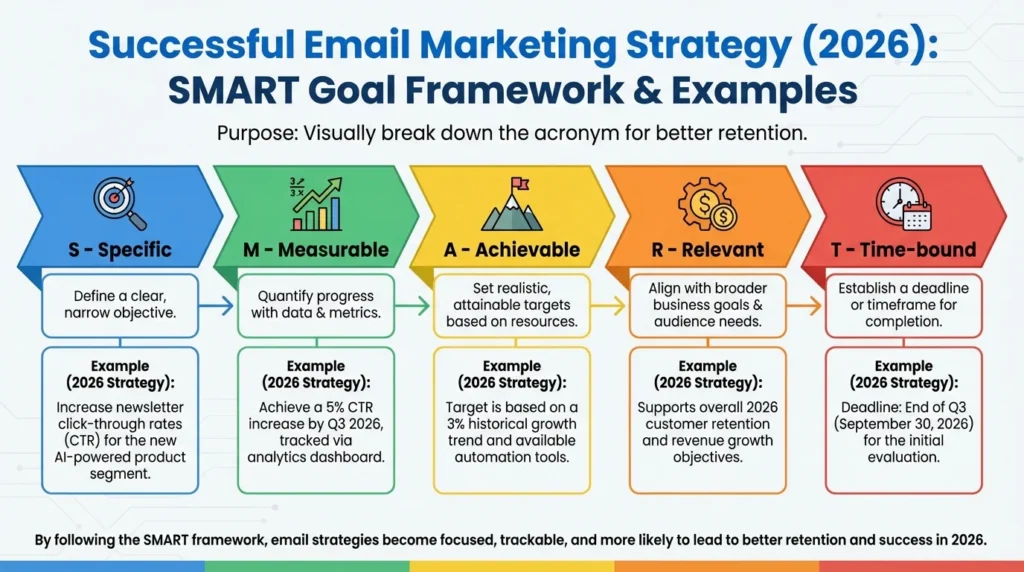
Set SMART Goals
Your objectives should be Specific, Measurable, Attainable, Relevant, and Time-oriented.
- Bad Goal: “I need to make more sales from email.”
- SMART Goal: “I am looking to grow email-attributed revenue by 15% in the next quarter and will do so with abandoned cart automation.”
Common Email Marketing Goals
- Increase Sales: Generating revenue through promotions and product launches.
- Create Leads: Cultivating leads for either sales team or high-end service.
- Develop Brand Loyalty: Community building and keeping your brand top-of-mind.
- Maximize Customer Retention: Lower churn with post-purchase follow-ups and win-back campaigns.
- Drive Traffic To Your Website: Promotion of new blog posts, videos or any other content.
After you set your aims, determine the Key Performance Indicators (KPIs) that will help gauge success. These are your open rate, click through rate (CTR), conversion rate and unsubscribe rate.
Define and Get to Know Your Audience
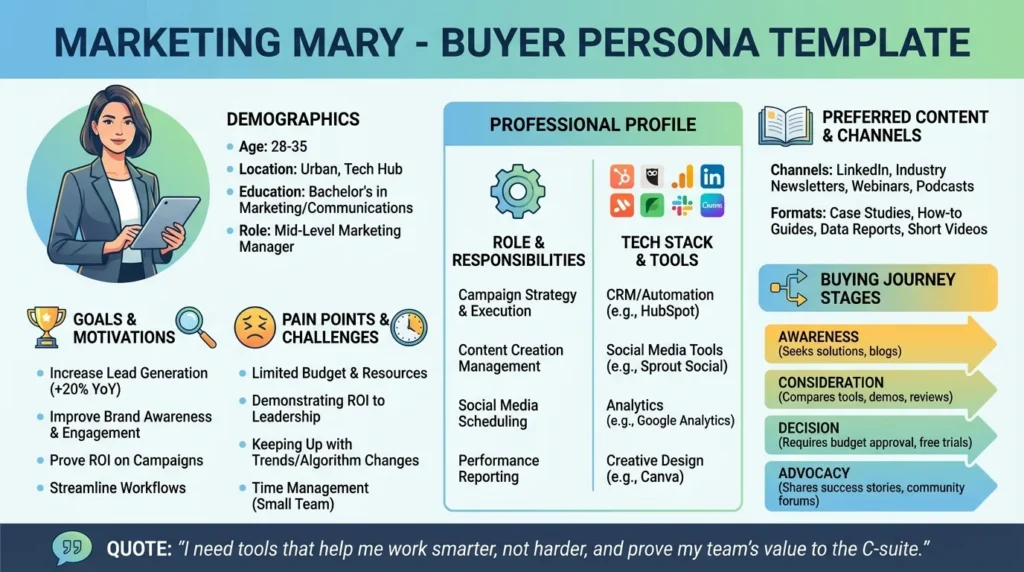
If you have no idea who you are speaking to, then how can you create content that will resonate? Don’t just stop at basic demographics; you want to develop a rich “Buyer Persona” (a semi-fictional representation of your ideal customer) for your business.
Key Questions to Answer
- Demographics: How old are they, where do they live, what is their job title?
- Pain Points: What are they trying to fix? What keeps them up at night?
- Goals: What are they trying to accomplish? How will your product or service solve their problem?
- Watering Holes: Where do they gather online? What blogs do they read? Where do they spend their time on social media?
Real-World Example
A business that creates project management software isn’t simply wanting to land “businesses.” Their identity might be “Marketing Mary,” a 35-year-old marketing manager at a mid-sized tech company who has trouble meeting deadlines and coordinating team communication that’s all over the place. That picture allows them to write emails that directly address Mary’s challenges.
Selecting the Right Tools and Technology
The engine of your strategy is your Email Service Provider (ESP). And the best platform can do more than just send your emails: It will help you maintain your list, automate workflows, and measure impact.
Issues to Think About When Deciding on an ESP
- Friendliness: Is the platform easy to use, including its interface and email editor?
- Integrations: Does it integrate well with your website, e-commerce store or CRM?
- Automation: How strong and widely known is its suite of automation?
- Segmentation Features: How simple is it to segment your list into specific categories?
- Price: Reasonable as the list grows?
Top Business Types by Platform Selected
- For Ecommerce: Klaviyo or Omnisend (both have great integration with Shopify).
- For Creators/Bloggers: ConvertKit (creator-focused features).
- For Small Businesses: MailerLite or Mailchimp (bang for your buck and ease of use).
- For B2B/SaaS: ActiveCampaign (strong CRM & automation).
[Suggested image: Comparison table or icons of top ESP logos with key features – purpose: aid in quick platform evaluation]
Build Your Email List Organically
Your tactics are valueless in and of themselves. Your email subscriber list is an asset to your business and it needs to be created with the proper consent. Never buy an email list.
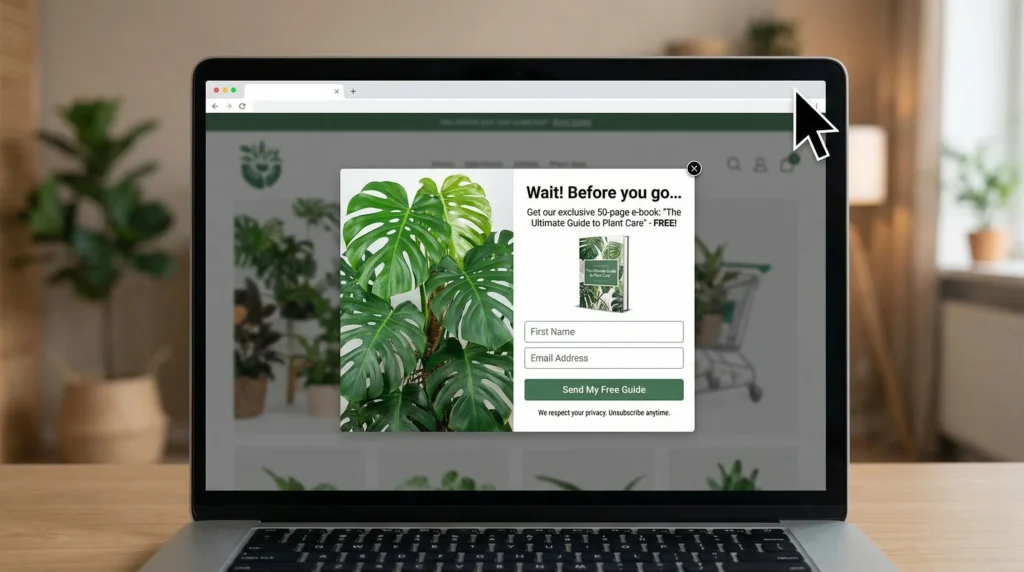
Create a Compelling Lead Magnet
A lead magnet is the free resource you give to someone in exchange for their email address. It has to have some worth, else why is the transaction taking place?
- E-commerce: “Take 15% off your first order.”
- SaaS: “Try free for 14 days” or “The Ultimate Guide to [Topic].”
- Consultant: “Free 30-minute strategy call” or a case study.
- Blogger: A list, template or behind-the-scenes video.
Optimize Your Website for Signups
- Pop-up Forms: Choose from Exit-Intent or Timed display pop-ups to showcase your offer.
- Embedded forms: Add signup forms to the footer and sidebar of your website, or within blog posts.
- Landing Pages: Build landing pages for your lead magnets to convert more of your traffic.
Create a Content and Campaign Strategy
This is the bread and butter of your email marketing success. You should have a plan for two kinds of emails: one-off campaigns and automated flows.
One-Time Campaigns (Broadcasts)
These are not automated follow up tidbits, these are special sending for specific occurrences. Schedule these on a content calendar.
- Newsletters: Round-ups of content, news, and tips delivered by email either weekly or monthly.
- Promotional emails: Sales, new products and seasonal offers.
- Announcements: Announce company news, new events or webinars.
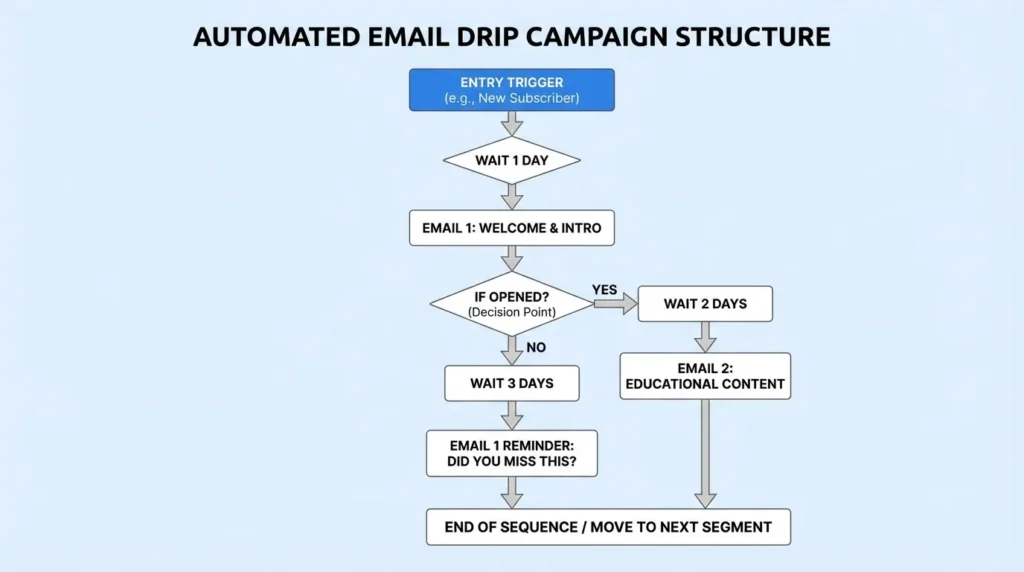
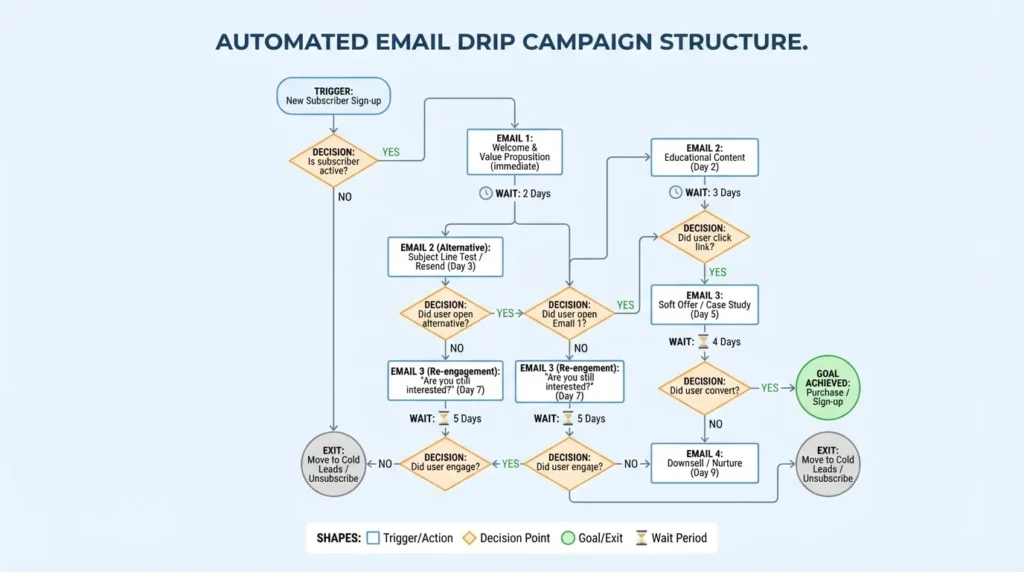
Automated Flows (Drip Campaigns)
These are sequences generated in response to user actions. They’re the linchpin that will scale your efforts.
- Welcome Series: Helps create and solidify a strong brand presence with newcomers.
- Abandoned Cart Series: Retain lost sales for your e-commerce store.
- Post-Purchase Series: Thank your customers, request reviews and prompt repeat purchases.
- Re-engagement/Win-Back Series: Targets dormant subscribers with an aim to re-engage them.
Master Segmentation and Personalization
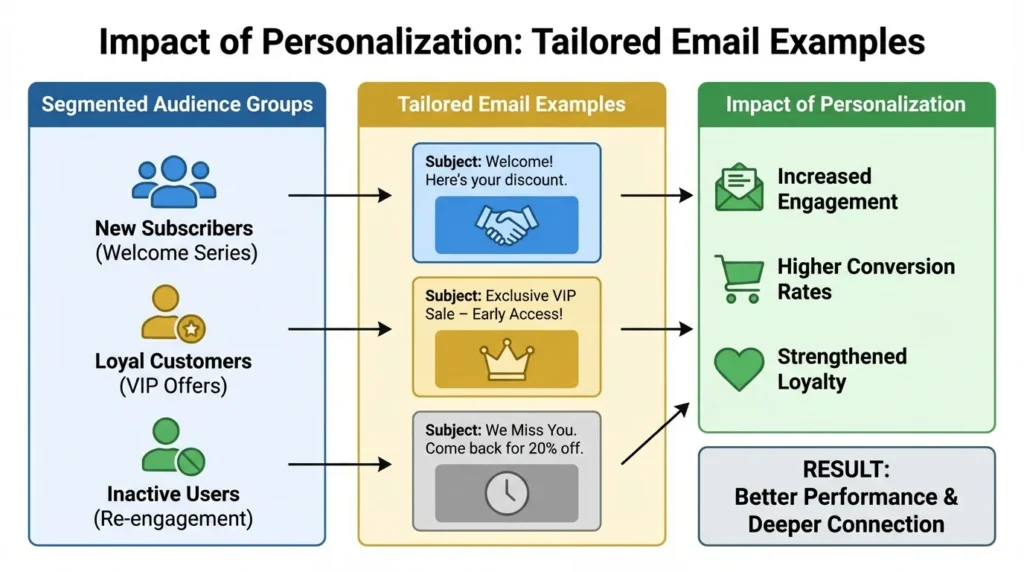
When you send the same message to everyone in the networks on your list you shoot yourself in the foot. Segmentation is when you divide your list up into smaller, more targeted groups.
Powerful Segmentation Strategies
- Demographic: Categorise based on age, sex or location.
- Behavioral: Segment by website activity, email engagement (openers vs. non-openers) or purchase behavior.
- Lifecycle Stage: Split by new signups, active customers, VIPs or lapsed customers.
Personalization in Action
Rather than blasting every email to every subscriber, you can create segments during the sign-up process based on purchase history or engagement (or absence thereof), and send each segment specific types of email. So a retailer might create a unique segment for customers who’ve previously purchased men’s clothes, and then target them with an email specifically offering more men’s apparel. Which is making this kind of targeting: i) HIGHLY relevant. And as a result has dramatically increased click-through rates and conversion….
Measure, Analyze, and Optimize
A good email marketing strategy is a living document. It needs to be continually fine-tuned by using data. Monitor your KPIs for each campaign and automation that you launch.
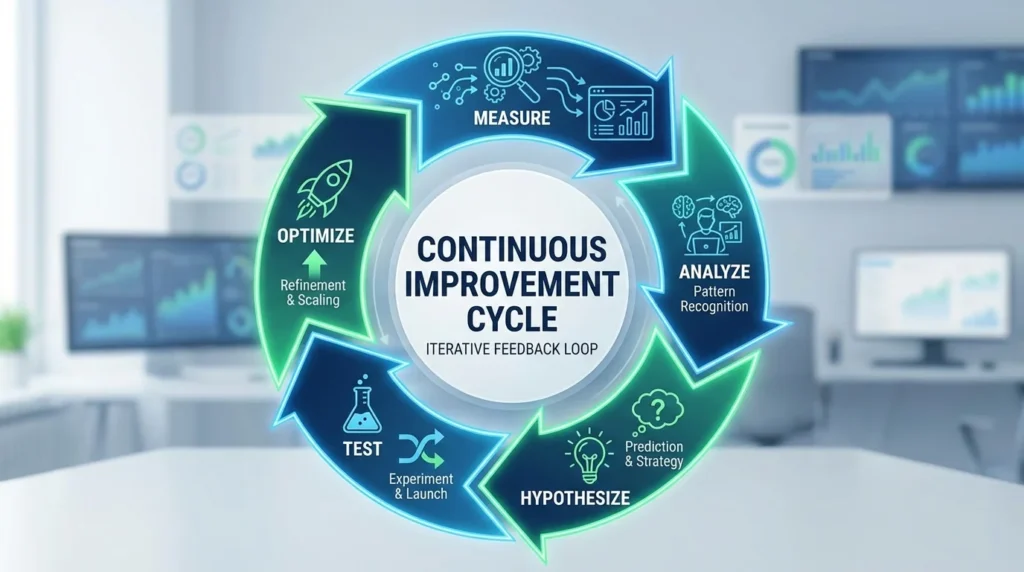
The Feedback Loop
- Measure: Examine your open rates, click-through rates and conversions.
- Analyze: Ask “why.” Why was this subject line better than the last one? Why did the CTR go down for this e-mail?
- Hypothesize: Form a hypothesis. “I think inserting an emoji in your subject line will boost open rates.”
- Test: Run an A/B test. For half of your list, send Version A (with no emoji), and for the other half, send Version B (emojis included).
- Optimize: Assuming your hypothesis is correct, make the winning version your new baseline. Then, rest up and start the process again with a new test.
Continuous optimization is how you make a good strategy great.
Conclusion: Your Blueprint for Success
The old saying “set it and forget it” does not apply to email marketing – but an effective strategy is a cycle which revolves around planning, doing and revising. It’s truly about knowing your audience so well that your emails are no longer sales-y and are more like helpful advice from a friend.
By having clear objectives, building a subscriber list, combining quality content and strategic automations, and dedicating yourself to testing and optimization based on data – you will build more than a marketing channel. You are constructing a long-term, fully scalable engine for business growth that will pay dividends for years to come.
Frequently Asked Questions (FAQs)
How frequently should I be emailing my list?
There is no magic number, but regularity is important. 1-3 times per week for most businesses would be ideal. The correct frequency matters based on what industry you’re in and the expectations of your users. Keep an eye on your unsubscribe rates — if you see a spike, you might be emailing too frequently.
What’s the key to a successful email marketing campaign?
But as with all things, this process has several moving parts, and building a solid, permission-based email list is where it all begins. All the best content and automations won’t matter without an interested audience who looks forward to your messages.
How will I know if my plan is working?
You have a few good KPIs you’ve identified from your goals; if they’re ticking off, then it’s working. And if you were aiming to boost sales, are you getting lift from email-attributed revenue? If you were seeking to cultivate loyalty, do open and click rates remain high over time?
What is a “drip campaign”?
An automated email sequence (or “flow”) is another name for a drip campaign. They are a set of pre-written emails that automatically send (a “drip”) to your subscribers over time after they perform an action (like joining your list).
Segmentation vs. personalization: What’s the difference between segmentation and personalization?
Segmentation means breaking apart your audience into segments, such as “cat owners.” Personalization is displaying the content to a person in that group such they are more likely enjoy it, based on your data (e.g. by addressing them by their name or showing the cat toy that they saw). Segmentation is the “who,” and personalization is the “what.”
My open rates are low. Is my strategy failing?
Well, not always, but it’s an indication something needs to be adjusted. The most common reason for poor open rates is either a lousy subject line or an uninvolved list. First, A/B test your subject lines. If that fails, you might try running a reengagement campaign to “clean” your list of non-responding subscribers.