
Google Display Ads Campaign Strategy: Driving 859 Visits on an $8.58 Budget at $0.01 CPC
Maximizing brand awareness on a micro-budget requires aggressive placement filtering, custom dayparting, and strict device controls. This long-running Google Display Network (GDN) campaign was built to sustain steady retargeting and top-of-funnel discovery without unnecessary ad spend waste.
By synchronizing night-time and weekend ad delivery with prime demographic cohorts, the campaign captured 14.1K impressions and 859 qualified clicks on a total ad spend of just $8.58—achieving an extraordinary average CPC of $0.01 and a 6.09% Click-Through Rate (CTR).
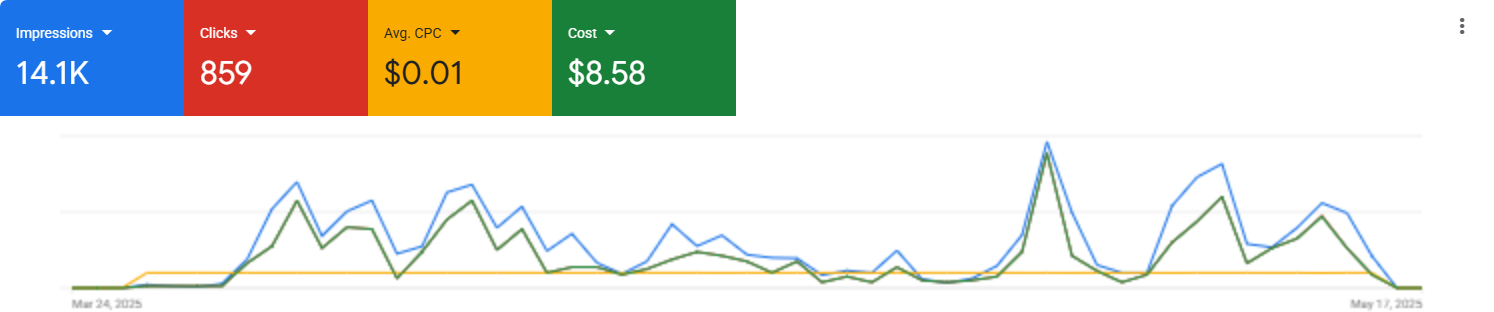
Campaign Performance Overview
Running over an 8-week period, the campaign maintained consistent engagement surges while capping bid costs at bottom-tier pricing across the display ecosystem.
Results
- Total Ad Spend
- Impressions
- Clicks
- Avg. CPC
- CTR
- $8.58
- 14.1K
- 859
- $0.01
- 6.09%
- Controlled Test
- Cost-Efficient Reach
- Direct Discovery Traffic
- Display Avg ($0.30–$0.60)
- GDN Benchmark (~0.60%)
Demographic
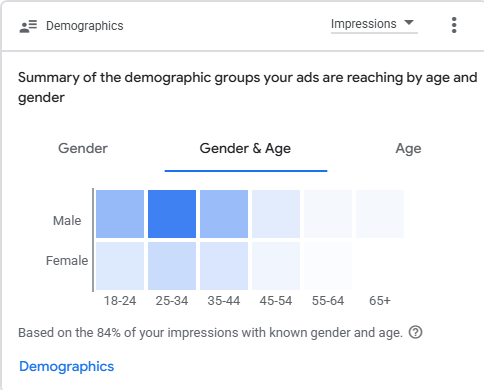
Demographic Audience Targeting
Impression delivery was concentrated on active digital shoppers and household decision-makers:
Primary Cohort: Men aged 25–34 represented the largest share of overall ad exposure, followed closely by men aged 18–24 and 35–44.
Female Audience Reach: Maintained stable reach across the 18–44 age brackets to ensure balanced product discovery across relevant lifestyle segments.
Custom Ad Scheduling & Dayparting
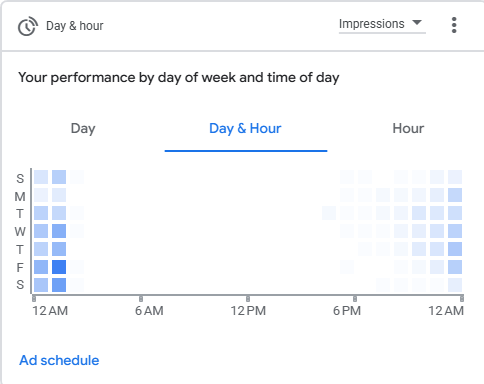
Rather than running 24/7 and depleting budget during inactive hours, ad delivery was targeted around verified high-engagement windows:
Night-Owl & Late-Evening Focus: Delivery peaked heavily between 8:00 PM and 2:00 AM, aligning with peak casual mobile browsing times.
Weekend Surge: Highest delivery density occurred on Friday and Saturday nights, capturing shoppers during leisure hours when click-through intent is highest.
Daytime Budget Suppression: Ads were restricted during early morning and business hours (6:00 AM – 12:00 PM) to avoid low-intent, accidental clicks.
Device
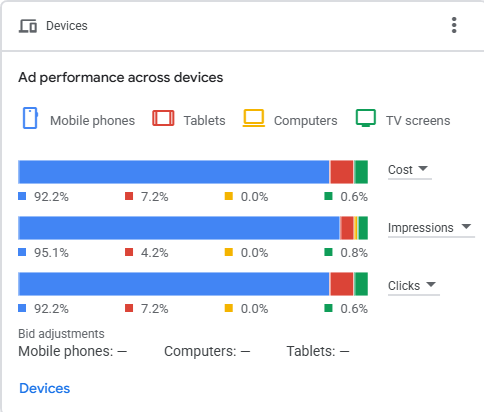
Device Optimization & Efficiency
Budget allocation was directed almost entirely to personal handheld devices:
- Mobile Phones: Captured 92.2% of clicks (95.1% of impressions) on a 92.2% cost share, serving as the primary traffic engine.
- Tablets: Contributed 7.2% of clicks (4.2% of impressions) at a 7.2% cost share.
- Computers: Reduced to 0.0% spend and impressions, successfully eliminating desktop budget waste.
- TV Screens: Generated 0.6% of clicks (0.8% of impressions) at a minimal 0.6% cost share.
What Made This Display Campaign Effective
Ultra-Lean CPC Bidding: Maintained a $0.01 CPC floor throughout the entire 8-week duration, squeezing maximum traffic value from a sub-$10 budget.
Zero Desktop Waste: Complete exclusion of non-performing desktop placements preserved every cent for high-converting mobile users.
Behavioral Dayparting: Concentrating spend exclusively on late-evening and weekend windows pushed the CTR to an exceptional 6.09%.
Looking to Maximize Your PPC Efficiency?
Whether scaling high-spend campaigns or squeezing massive value out of test budgets, profitable advertising depends on disciplined bidding, smart scheduling, and continuous placement refinement.
“Good PPC isn't about spending more. It's about making every click count.”
Maruf Sheikh
Google Ads & E-Commerce Performance Marketer


